
Is Cheat Engine Safe? What the Warning Means
Cheat Engine is one of the oldest tools in PC gaming, its source code is public on GitHub, and Windows Defender still stops the installer more often than not. Both facts are true at the same time. The program is safe when it comes from its own site. The warning is about what it does, not about who made it, and the real risks sit somewhere else entirely.
Takeaways Cheat Engine, the safety picture
- Open source, public code The whole project is on GitHub with 19,200 stars. Anyone can read what it does. Version 7.7 shipped on 29 May 2026.
- Flagged because of what it does It attaches to other programs, reads their memory and writes into it. Antivirus heuristics call that a hacking tool, whoever is holding it.
- The download source is the risk Repacked copies from mirrors and video descriptions are where real malware travels. Its own site and GitHub are the only two places to get it.
- Never with an online game running Anti-cheat systems detect the process itself. A single-player game on your own PC is the only place it belongs.
What Cheat Engine is
Cheat Engine is a memory scanner with a debugger attached. You start a game, you attach Cheat Engine to it, you search for the number you see on screen, you change it. The site describes it as a tool to mod your games, adds that it is for private and educational purposes only, and asks users to be 18 or older. Version 7.7 came out on 29 May 2026.
The project is open source. The repository on GitHub has 19,200 stars and describes itself as a development environment focused on modding games and applications for personal use. Anyone can read the code, and plenty of people have. That is the first half of the answer: the program itself is not hiding anything.
Why antivirus software flags it anyway
The second half is about behavior. Cheat Engine opens another process, reads its memory, writes into it, sets breakpoints and injects code. Every one of those actions is also what malware does when it tampers with a program, and antivirus software does not judge intent. It matches behavior.
Microsoft keeps a category for exactly this kind of software: potentially unwanted applications. In its own definition, a PUA is not a virus, malware, or other type of threat, but software that might do things on a machine that affect its use, and the list of examples includes software that tries to evade security products or that bundles other software. A memory editor with a debugger sits close enough to that description that Defender flags it, and third-party scanners often go further and call it a hacking tool outright.
So the warning is real and the software is not malicious. Both are true. What the warning cannot tell you is whether the copy you downloaded is the real one.
Where the actual risk is
Cheat Engine’s name is well known, and anything well known gets copied. Repacked installers on mirror sites, download links under videos, forum attachments with a helpful readme: this is where malware travels, dressed as a tool people already expect their antivirus to complain about. The complaint then looks like the usual false alarm, and that is the trick.
The rule is short. Download from cheatengine.org or from the GitHub releases page, nowhere else. Read every screen of the installer. If a copy arrived any other way, do not add an exclusion for it; delete it. The guide on antivirus warnings explains how to tell a heuristic flag from a real detection and what an exclusion costs.
The second risk is not about malware at all. Cheat Engine attached to an online game is detected as a process by the anti-cheat, and the ban that follows is not a false positive. Single-player, offline, your own PC: that is the whole territory.
What it is like to use
Cheat Engine is a tool, not a switch. You search for a value, narrow it down by changing it in the game and searching again, and when you find the address you edit it. For a simple number like gold that takes a minute. For a value the game stores in a form you cannot see, a percentage, a float, an encrypted counter, it takes a tutorial and an evening. The pre-made tables people share for specific games are a shortcut, and they break with every patch, which the Palworld guide describes from the player’s side.
That is the honest comparison with a trainer. A trainer is Cheat Engine’s result without the search: someone found the addresses, wrapped them in switches with hotkeys, and keeps them updated. The Cyberpunk 2077 trainer, for example, carries its skill cheats twice, once for the old progression system and once for the one patch 2.0 introduced, which is exactly the kind of maintenance a table needs and rarely gets. The four ways to cheat on PC are compared in their own guide, and how to set up a trainer is a page of its own.
So, is it safe
Yes, from its own site, on a single-player game, with the installer read screen by screen. The antivirus warning is about the category of tool, and it will keep coming. The danger is a copy from somewhere else, and the ban is a game with other people in it. Everything in between is a memory scanner doing what it says.
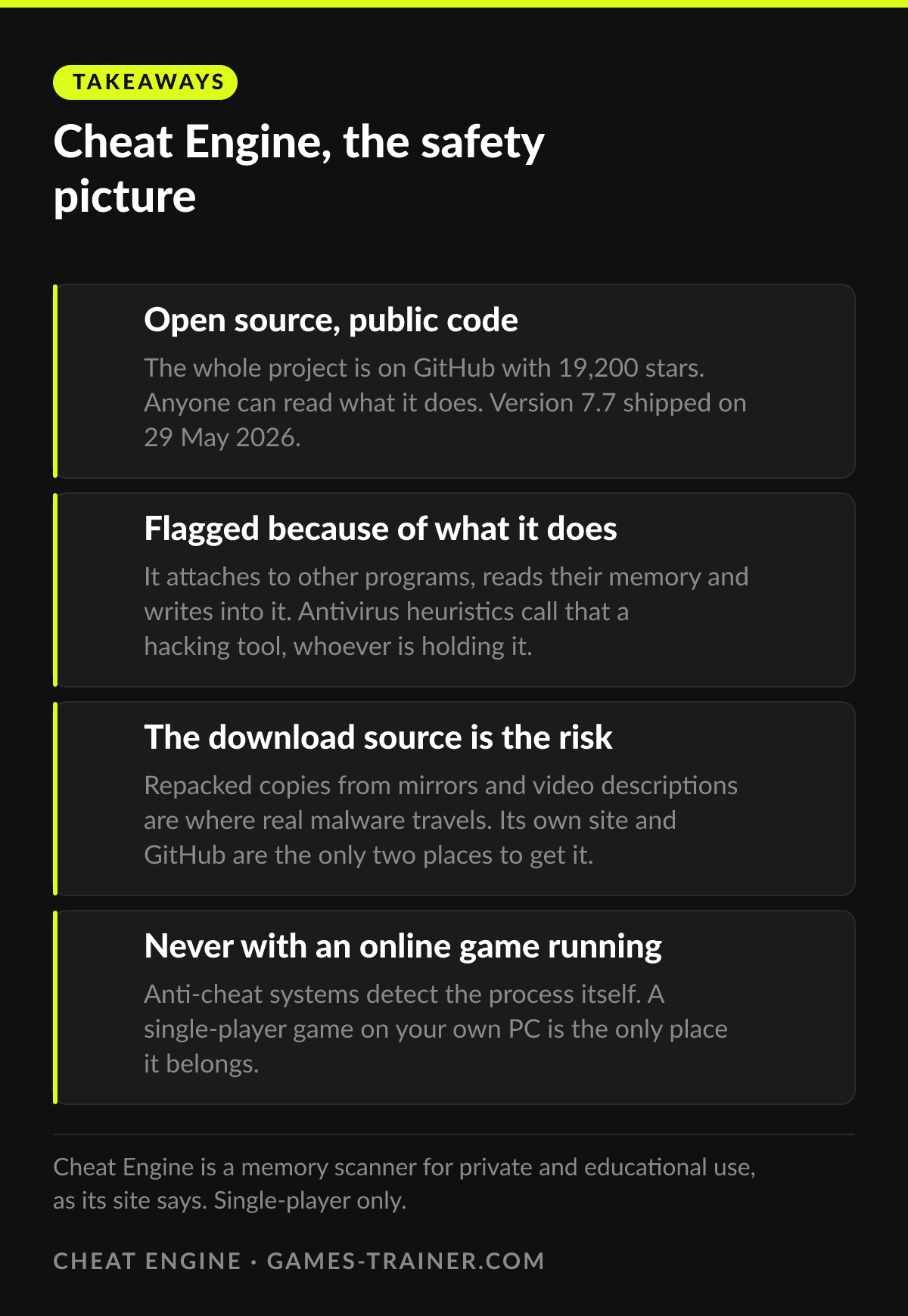 Infographic Cheat Engine, the safety picture Click to enlarge
Is Cheat Engine a virus?
No. It is an open-source memory scanner whose code is public on GitHub. Antivirus software flags it because it does what malware also does, attach to a process and change its memory. The flag is about behavior, not about an infection.
Why does Windows Defender block Cheat Engine?
Because the program reads and writes the memory of other programs and includes a debugger. Defender classes such tools as hacking tools or potentially unwanted applications, which is a behavior category, not a malware verdict.
Where should I download Cheat Engine?
From cheatengine.org or from the project's GitHub releases. Anywhere else, especially a repacked copy from a video description, is where real malware travels under the tool's name.
Can I use Cheat Engine in an online game?
No. Anti-cheat systems detect the process, and a ban follows. Keep it to single-player games on your own PC, and close it before you open anything with other people in it.