
Can You Get Banned for Using a Trainer?
A trainer in a single-player game changes numbers on your own PC, and nobody is checking. A trainer in a game with other people in it is a different act, and anti-cheat software is built to catch exactly that. The systems differ in how they watch and how they punish, but the line between them is the same everywhere: is anyone else in the session.
Takeaways Where anti-cheat is and where it is not
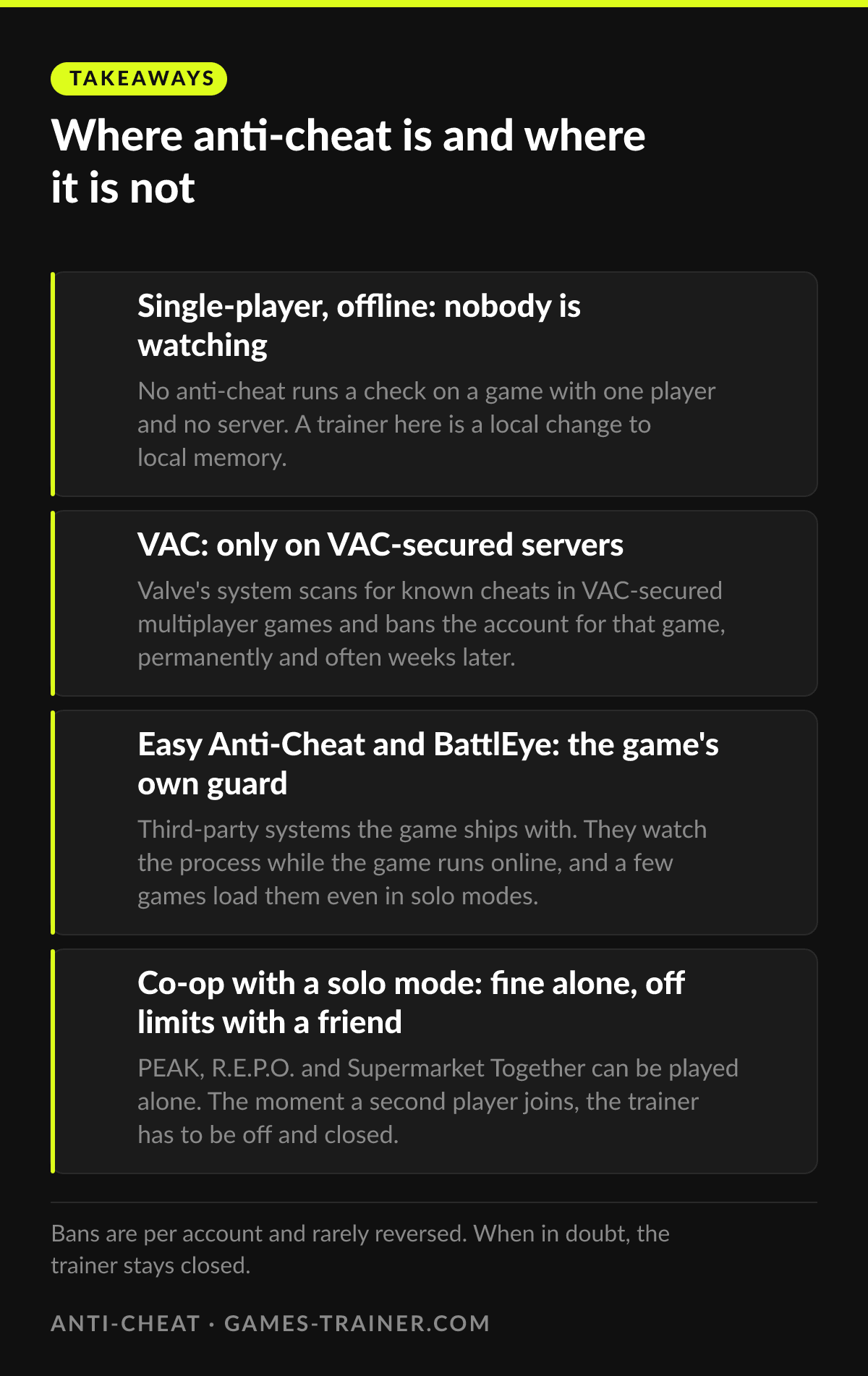
- Single-player, offline: nobody is watching No anti-cheat runs a check on a game with one player and no server. A trainer here is a local change to local memory.
- VAC: only on VAC-secured servers Valve's system scans for known cheats in VAC-secured multiplayer games and bans the account for that game, permanently and often weeks later.
- Easy Anti-Cheat and BattlEye: the game's own guard Third-party systems the game ships with. They watch the process while the game runs online, and a few games load them even in solo modes.
- Co-op with a solo mode: fine alone, off limits with a friend PEAK, R.E.P.O. and Supermarket Together can be played alone. The moment a second player joins, the trainer has to be off and closed.
The line is people, not the game’s name
Every trainer page on this site says single-player, and the reason is not politeness. Anti-cheat systems exist to protect other players, so they watch games where there are other players. A single-player game with no server has nobody to protect and nobody watching. A trainer there is a local change on a local machine, and the only person affected is you.
The moment a second person is in the session, the same trainer is a different act, and the game’s anti-cheat is built to catch it. That is the whole rule. The rest of this page is how the main systems apply it.
VAC: Valve’s system, on Valve’s servers
Valve Anti-Cheat is the one most people have heard of because the ban shows on a Steam profile. Valve’s own description and the public record of how it works agree on the scope: VAC detects cheats on VAC-secured servers, and when it finds one it bans the account from VAC-secured servers for that game, permanently. The ban is delayed, often by days or weeks, and Valve does not tell you what it found or when.
Two things follow. VAC is not on your machine scanning single-player games; it is attached to secured multiplayer servers, and a game with no such servers has no VAC. And a VAC ban is not a ban from Steam. It is a ban from that game’s secured servers, on that account, forever.
Easy Anti-Cheat and BattlEye: the game’s own guard
The other two names you will meet are Easy Anti-Cheat, owned by Epic Games since 2018, and BattlEye. Both are shipped by the game rather than the store, both install a driver, and both watch the game’s process for tampering while the game runs online: injected code, modified memory, known tools. The ban comes from the game’s publisher, not from the platform, and how long it lasts is the publisher’s decision.
The complication is that a handful of games load these systems even in solo modes. Far Cry 5 and Watch Dogs 2 became examples for shipping Easy Anti-Cheat in single-player, which is why the safe assumption with any game that installs an anti-cheat driver is that the guard is up whenever the game is. If a game has an anti-cheat and no separate offline mode, that is a game to leave alone.
Co-op games with a solo mode
This is where most real questions land. Supermarket Together supports up to sixteen players and can be run alone. PEAK is a four-player climb that works solo and offline. R.E.P.O. is a six-player extraction game with single-player listed on its store page. In each, a trainer in your own solo session, say the PEAK trainer with its thirteen affliction resets, affects nobody, and in each, a lobby with one more person in it is multiplayer.
The practical rule is stricter than it sounds: the trainer is off and closed before a friend joins, not paused. Anti-cheat detects the process, not the switch.
What a ban actually is
An anti-cheat ban is applied to the account, not to the copy of the game. It is rarely reversed, because the systems are built to avoid false positives by design, and appeals are handled by the publisher on their terms. A VAC ban is visible on the profile. An Easy Anti-Cheat or BattlEye ban usually means the online mode of that game is gone for that account. None of that is worth the money in a co-op supermarket.
The two questions people mix up
Antivirus and anti-cheat both react to the same behavior, a program writing into another program’s memory, and they react differently. Antivirus warns and asks; that is the flag on the download. Anti-cheat does not warn. It records and, later, bans.
So a trainer that your antivirus has learned to tolerate is not one that an online game will. The setup guide ends on the same line this one does: single-player only, and closed before anyone else is in the room.
 Infographic Where anti-cheat is and where it is not Click to enlarge
Can you get banned for using a trainer in single-player?
No. A single-player game with no server has no anti-cheat checking it. The trainer changes values in memory on your PC, and there is nobody to report to. Achievements are a separate question with a per-game answer.
Does VAC ban you for cheating in single-player games?
VAC operates only on VAC-secured servers in multiplayer games. Valve's documentation describes it as detecting cheats on those servers and banning the account for that game. It does not monitor single-player play.
What about Easy Anti-Cheat and BattlEye?
Both are systems a game ships with, and they watch the game's process while it runs online. A few games load them in solo modes as well, so with those titles the safe assumption is that the guard is up whenever the game is.
Is a co-op game safe to cheat in when I play alone?
If the game offers a true solo mode and you are the only player, yes. The trainer must be off and closed before anyone joins. A lobby with a second person is a multiplayer game, whatever the game calls it.